The first day of the annual convention of Alberta’s United Conservative Party (UCP) on November 28 was expected to be a triumphal moment for Alberta Premier Danielle Smith. After all, the negotiation of a Canada-Alberta Memorandum of Understanding (MOU), signed by both Smith and Prime Minister Mark Carney the previous day, was hailed by the Premier as showing that “Canada still worked for Alberta,” at least when her government exerted the right amount of pressure. The Premier was therefore visibly stunned when her announcement of the MOU was met with heavy booing from many conference delegates.
Arguably, the delegates had every reason to celebrate: support for pipelines had dramatically increased in Canada after Donald Trump’s inauguration on January 20. On top of the completion of the Trans-Mountain Pipeline by the Trudeau government in May 2024, the new Carney Liberal government had delivered the end of the consumer carbon tax, the resignation of environmentalist Steven Guilbeault from cabinet, the announced goal of an energy corridor across the country and, in the MOU, an expression of willingness to build a second pipeline to the west coast in the next decade.
Ottawa’s only demands in return were Alberta’s commitment to the Pathways Carbon Capture Project and an associated carbon price of at least $130 per tonne. The agreement exempted the pipeline project from climate legislation such as the greenhouse gas emissions cap, and found a more southern route to avoid the north coast tanker ban. The Premier defended the agreement as addressing seven of the nine demands that she had made on behalf of Alberta during the previous federal election.
To be sure, the chorus of boos was something of a staged event, engineered by separatist lawyer Jeffrey Rath, one of the cofounders of the Alberta Prosperity Project. Nevertheless, the Alberta-Ottawa MOU continued to get a mixed reception on the following day of the convention. The discontent was accompanied by distribution of a flyer to the delegates for the election of “pro-independence” as opposed to “pro-establishment” candidates to the party’s board of directors (though short of a majority, they obtained a large minority). Premier Smith’s keynote address attempted to reassure her party that the agreement with Ottawa was a “clear win” for Alberta and that she would continue to “fight for Alberta.” It was abundantly clear, however, that Smith is riding a separatist tiger that she cannot fully control.
Smith’s populist radicalism spawns a growing opposition
When the United Conservative Party of Alberta was established in July 2017, the Wild Rose Party was clearly the junior partner in its merger with the Progressive Conservative Association of Alberta. The Progressive Conservatives had ruled Alberta continuously from 1971 until 2015, the longest unbroken run in Canadian history. The shock of losing power to the NDP in 2015 led the new PC leader, Jason Kenney – an energetic minister in the Harper federal government with a talent for organization – to spearhead the merger. To no one’s surprise, Kenney won the leadership of the new party over the Wild Rose leader, Brian Jean, by a margin of 61.2 per cent to 31.5 per cent, reflecting the dominance of the more moderate faction.
Danielle Smith was very much a bystander in that sequence of events. She had led the Wild Rose Party from October 2009 to December 2014, and often led in the polls before replacing the Liberals as the official opposition party in the 2012 election. Nevertheless, her floor-crossing to Jim Prentice’s PC government in 2014 failed to prevent the NDP from forming a government in 2015. Through the years of the NDP government (2015–19), the formation of the UCP and Jason Kenney’s term as Premier (2019–22) , she worked primarily as a talk radio host on CHQR in Calgary and as a lobbyist for the Alberta Enterprise Group, a corporate advocacy organization mostly representing oil and gas companies.
The principal reason that Jason Kenney was forced to hold an early leadership review in May 2022 was the deep unhappiness in a large segment of both the party and the caucus with several of Kenney’s public health orders during the COVID-19 pandemic. (He resigned after gaining a slim majority of just 51.4 per cent of party members in that vote.) The ensuing leadership contest was no cakewalk for Smith, however: she won the UCP leadership vote with only 53.77 per cent of the vote in the sixth round of voting, after fairly strong campaigns by runners-up Brian Jean and Travis Toews. A central plank of her leadership campaign was the promise to enact what she called the Alberta Sovereignty Act if she became premier, a proposal that drew fire from the other leadership candidates as well as from former Premier Kenney, who called it “a full frontal attack on the rule of law.”
Smith’s campaign for the UCP leadership also curried favour with the antivax members of the party, pointing to her longstanding opposition to vaccine mandates. She drew criticism for her comment that “everything that built up before you got to stage 4 (of cancer) and that diagnosis – that’s completely within your control” and her suggestion that her Health Savings Account proposal (a popular idea in Republican circles in the United States as a substitute for Medicare and Medicaid) could help with that by allowing people to choose naturopathic and lifestyle alternatives.
True to her word, when Smith became Premier, the first piece of legislation that she introduced was Bill 1, the Alberta Sovereignty Within a United Canada Act. Amendments were made to curb the sweeping powers the bill initially gave to cabinet to rewrite legislation and second-guess judicial decisions about constitutional jurisdiction. However, as then–NDP leader Rachel Notley maintained, it still arguably “gives broad, undefined power to cabinet to direct municipalities, health regions, schools and city police forces to resist implementing federal laws.”
The past three years have seen a steady flow of attempts to aggressively assert Alberta’s provincial jurisdiction, coupled with a long list of (mostly populist, often MAGA-inspired) innovations. In a disturbing echo of the Alberta Sovereignty Act, the government introduced legislation (Bill 14) that would permit an independence referendum to proceed by ending all court actions against it – including those based on Charter of Rights and First Nations Treaty obligations.
In a sharply worded ruling, Calgary Court of King’s Bench Justice Colin Feasby stated that “legislating to pre-emptively end this court proceeding disrespects the administration of justice.” A defiant Premier stated the following day on her radio talk show that “the will of Albertans is not expressed by a single judge appointed by Justin Trudeau and never faces any kind of recall campaign, never faces any kind of election,” adding that “judges should not be gatekeepers on independence questions.” The government has also invoked the notwithstanding clause to order striking teachers back to work (even though the teachers were willing to accept arbitration) and to pass a bill affecting transgender citizens.
In the realm of health policy, Smith refused to back down from her controversial comment that the unvaccinated and people resisting COVID-19 mandates were “the most discriminated against group that I’ve ever witnessed in my lifetime.” She further endeared herself to her base by firing Chief Medical Officer Deena Hinshaw, who had led the province’s medical response during the pandemic, and by withdrawing Alberta from the World Economic Forum’s Global Coalition for Value in Health Care, a global health consulting agreement (the WEF being a popular object of right-wing conspiracy theories). Ironically, Canada’s wealthiest province forces most of the population to pay $110 out of pocket for COVID vaccinations, and it is one of only two provinces to diverge from the recommendations of the National Advisory Committee on Immunization (NACI) in this respect.
More recently, and of no small historic significance, the Alberta government in November 2025 introduced Bill 11, the Health Statutes Amendment Act (no. 2), creating a “dual practice model” for physicians. This would allow some doctors to practise in both the public and private systems, charging patients for some procedures while providing others “free” through the publicly funded system. The policy aims to enhance access and shorten surgical wait lists by encouraging more operations in private clinics and on evenings and weekends but, as some journalists and health experts have pointed out, the devil is in the details.
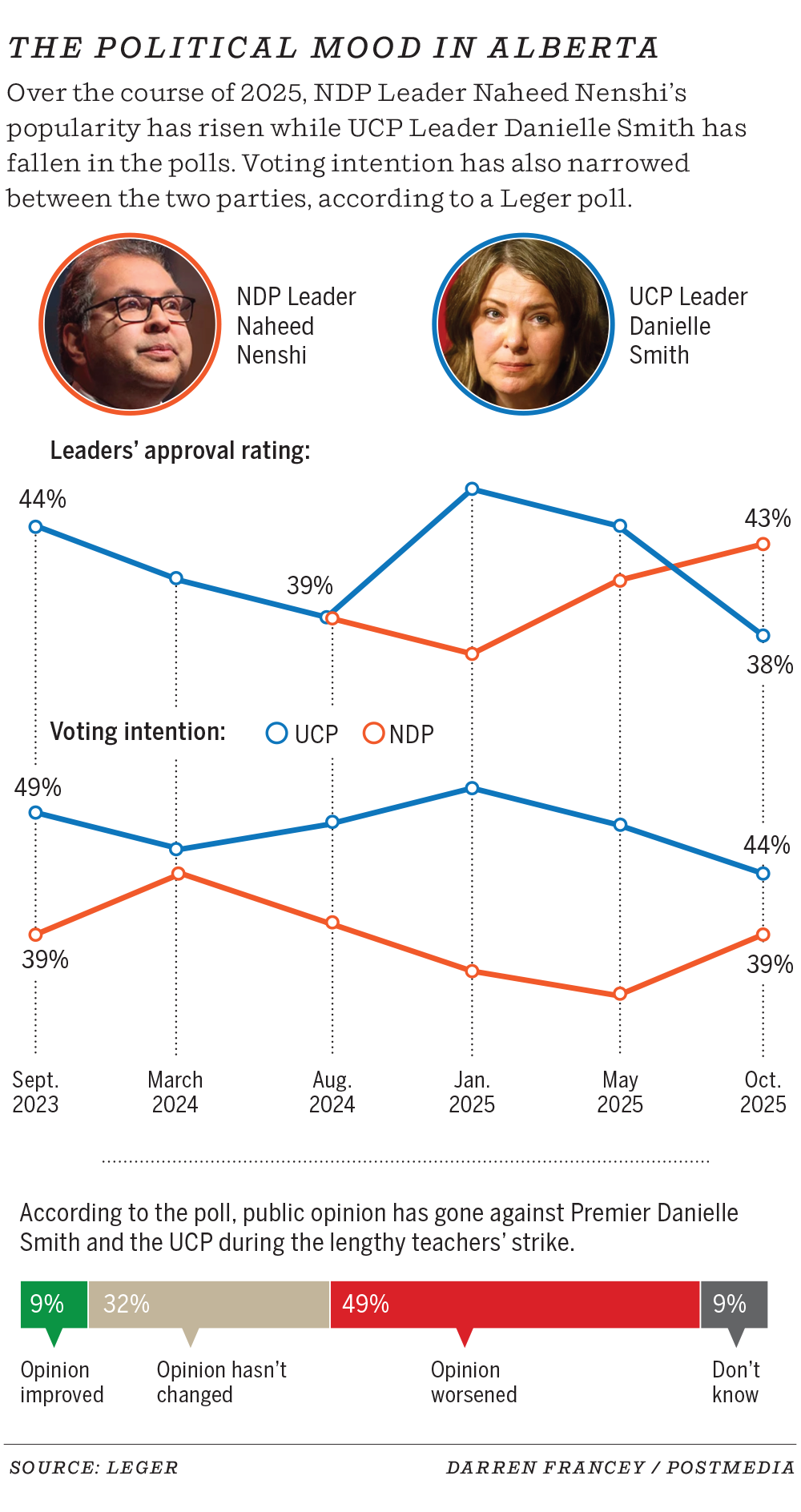
If the introduction of Bill 11 and the Alberta-Ottawa pipeline deal were the crowning achievements of the Smith government’s policy agenda, then its handling of the Alberta teachers’ strike may have become the province’s “defining political moment,” according to an analysis conducted by the Leger polling firm in late October. Similar polling conducted in late November and early December indicated that “the United Conservative Party’s handling of the labour unrest has worsened Albertans’ approval of the party … 41 per cent of respondents’ approval had worsened, 17 per cent had improved and 31 per cent stayed the same.”
The net result is that while the UCP still maintained a lead in the polls in the final month of the year, Opposition Leader Naheed Nenshi has gained support during 2025 while Danielle Smith has continued to be the most polarizing premier in the country, with 24 per cent of the province strongly approving of her leadership and 40 per cent strongly disapproving, according to an Angus Reid poll .
Some of her policies have been of longstanding interest to many average Albertans, such as the gun rights and provincial policing proposals. But for a significant section of the population, the policies calculated to appease a radical minority – especially those relating to health care and education – have led to 14 UCP MLAs facing citizen-initiated recall efforts to oust them from office.
What’s next for Alberta?
The Alberta Next Panel, a “province-wide consultation to chart our path, secure our economy, and assert our sovereignty within a united Canada,” has proceeded as envisioned in preparation for 2026 referendums, having conducted 11 town halls in 2025 to discuss six carefully framed “Policies and Actions for Discussion”: Federal Transfers and Equalization; Alberta Pension Plan (even though the government has long known that two thirds of Albertans want to stay in the Canada Pension Plan and only 10 per cent favour creating a provincial plan); Constitutional Changes (“to better protect provincial rights”); Provincial Police Force; Immigration; and Tax Collection (i.e. withdrawing from the joint tax collection agreement with the Canada Revenue Agency).
Unusually for a government task force, the panel was chaired by the Premier herself, reflecting the significance assigned to the governing premise that Ottawa Is The Problem. To be fair, when the panel was in its planning stages in 2024 and early 2025, Justin Trudeau was still Prime Minister, and immigration policy could more fairly have been described as being “out of control.”
Nonetheless, two or three things make observers wince. One is that the zombie issues of equalization (which was the subject of an Alberta referendum in October 2021) and an Alberta Pension Plan (to which the government will not take no for an answer, it seems) took a third of the panel’s allotted time when the province’s two-tier health care proposal (and many other policies) could have greatly benefited from greater public discussion and scrutiny. Another is the surreal nature of this prolonged Ottawa-bashing exercise during a year in which the external threat presented by Donald Trump and the need for a coordinated national and, indeed, patriotic response was so obvious.
As longtime Alberta politics observer David Climenhaga puts it, “the Frankenparty stitched together by Jason Kenney spawns a separatist monster in its ranks.” Will the more moderate, pro-Canadian majority simply vote with its feet and elect a Nenshi-led NDP? If oil prices start to fall, Smith may opt to call an early election in the fall of 2026. For the time being, however, Alberta will be like the MAGA plurality that reelected Trump in 2024: willing to accept a divisive culture war if it brings with it the hope of a better economy.